The Bay of Quinte region is full of properties that were never meant to be used in January — summer cottages, waterfront cabins, seasonal homes built for warm weather and weekend use.
More and more of them are becoming year-round homes. Retirees settling in, remote workers moving to the water, families converting the family cottage into a permanent residence. And every one of those conversions runs into the same wall: a building designed for summer is miserable and expensive to heat in an eastern-Ontario winter.
Spray foam is usually the heart of the fix. Here’s what a seasonal-to-year-round conversion actually needs.
Why summer buildings fail in winter
A seasonal cottage or cabin was built to a completely different standard than a year-round house:
- Little or no insulation — it didn’t need it for July
- Often on a crawlspace, piers, or posts — open or vented underneath, with cold air (or cold water air) circulating below the floor
- Uninsulated or single-pane windows
- No air sealing — it was built to breathe, not to hold heat
- Exposed or shallow water lines vulnerable to freezing
- Shallow roof cavities with no room for much insulation
Put a heater in that and you’ll spend a fortune while still being cold. Making it a real year-round home means bringing the whole envelope up to standard — and spray foam is the tool that does the most, in the awkward assemblies these buildings are full of.
The two products, briefly
| ½ lb open-cell | 2 lb closed-cell | |
|---|---|---|
| Approx. R per inch | ~R-3.5 – R-3.8 | ~R-6.0 – R-7.0 |
| Own vapour barrier? | No | Yes, at sufficient thickness |
| Moisture | Absorbs | Resists |
| Conforms to irregular surfaces | Yes | Yes |
| Best here for | Interior walls, sound | Crawlspaces, floors, rim joists, shallow roofs, waterfront moisture |
On the water, closed-cell is usually the workhorse — its moisture resistance matters near a lake, and its high R-per-inch suits the shallow cavities these buildings have.
½ lb open-cell → · 2 lb closed-cell →
Where spray foam does the work in a conversion
1. Under the floor — the crawlspace, piers, or posts
This is the single biggest issue in most seasonal properties, and the biggest source of cold floors and frozen pipes.
A cottage floor with open air underneath — over a vented crawlspace, or up on piers by the water — has nothing between the living space and the outdoor cold. In summer that’s pleasant. In January it’s brutal, and it puts your water lines at risk.
The closed-cell approach:
- For a crawlspace: fix any drainage first, lay a ground vapour barrier, then spray closed-cell foam on the crawlspace walls and rim, turning it into a sealed, conditioned space that protects the floor and the plumbing.
- For a pier/post foundation where the floor is exposed underneath: closed-cell foam sealed into the floor structure from below insulates and air-seals it — where access allows.
On a waterfront property, this also helps manage the moisture that comes with being near water.
Rebate note: crawlspace walls (up to $1,200), crawlspace ceiling (up to $1,200), and exposed floor ($300) are each rebate measures. Belleville rebate guide →
⚠️ Sealing a crawlspace under a converted cottage must be done as a system — vapour barrier, wall foam, rim joist, plus attention to any combustion appliances and radon. And near water, the moisture and drainage picture needs proper assessment first.
2. The walls
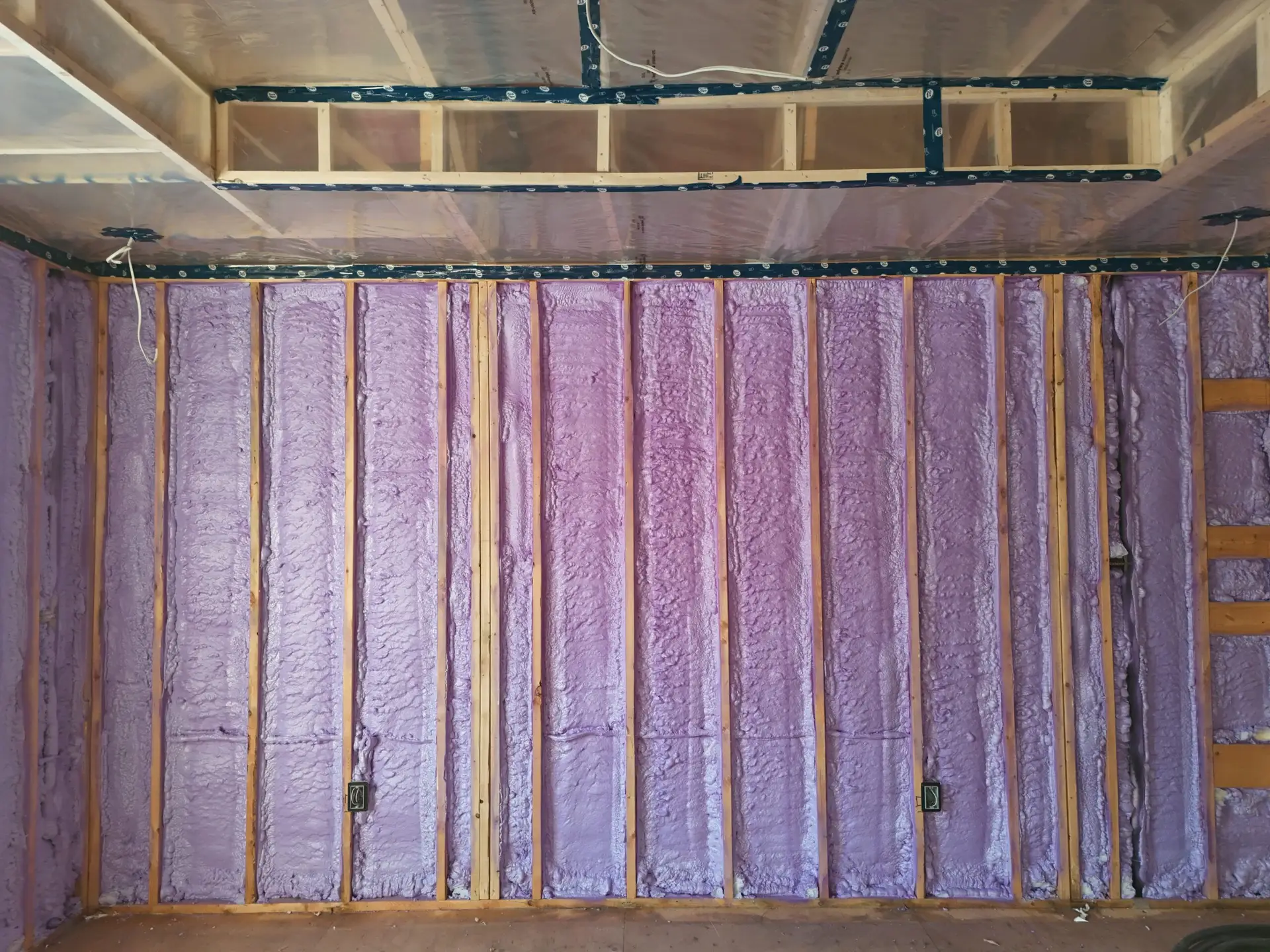
Seasonal buildings often have shallow or unusual wall construction. Where walls are open (during a conversion reno), closed-cell delivers the most R-value in limited depth and air-seals at the same time. Where they’re finished and can’t be opened, drill and fill can insulate them.
3. Shallow and cathedral roofs
Cottages love an open, beamed ceiling — which means little cavity depth. Closed-cell foam’s high R-per-inch is often the only way to get real thermal performance in a shallow cottage roof.
4. Rim joists and floor perimeters
The band around the top of the foundation (or the perimeter of a raised floor) leaks constantly. Closed-cell seals and insulates it — cheap, high-impact, and a qualifying rebate measure ($300).
5. Protecting the plumbing
A converted cottage’s water lines are often run for summer use — shallow, exposed, or in uninsulated spaces. Sealing and insulating the crawlspace and floor structure is also what keeps those pipes from freezing. It’s comfort and freeze-protection in one job.
The rule that matters double on the water: moisture first
Waterfront and near-water properties have moisture challenges an inland home doesn’t — higher humidity, higher water tables, sometimes seasonal flooding risk.
Insulation does not fix a moisture problem, and foam over damp or wet conditions hides it. Before any foam goes below or around a waterfront building:
- Drainage, grading, and any seasonal water issues understood and addressed
- The crawlspace or foundation’s moisture behaviour assessed
- Any flood-risk considerations accounted for
On the water, this step isn’t optional — it’s the difference between a conversion that lasts and one that grows mould in its second winter.
Where foam isn’t the answer
A standard attic, if the converted home has one with headroom — blown-in reaches full depth for less. Attic insulation →
Interior walls where you only want quiet — mineral wool for sound.
Over an unresolved water or drainage problem — always fix water first, especially near a lake.
Practical questions
Can you convert my cottage to a year-round home? The insulation and air-sealing side, yes — crawlspace, floors, walls, roof, rim joists. A full conversion may also involve heating, plumbing, and windows, which we’ll flag as part of the picture. We’ll tell you what the envelope needs.
Do I need to leave during spray foam? We install Insulthane Extreme by Elastochem and residents can generally remain; on an unoccupied seasonal property that’s rarely an issue anyway. We’ll discuss ventilation and re-entry, and flag any respiratory sensitivities. Crawlspaces with a furnace or water heater need combustion safety planned in.
Will this stop my cottage pipes from freezing? Sealing and insulating the crawlspace/floor structure is a big part of freeze protection, alongside proper plumbing runs. We’ll assess the whole picture.
Does closed-cell need a separate vapour barrier? At sufficient thickness it acts as its own. Assembly-specific, stated on the quote. Vapour barrier →
Does a seasonal-home conversion qualify for rebates? If it’s becoming your home (owned and occupied), the standard eligibility applies — and crawlspace, floor, wall and rim-joist measures each qualify depending on R-values and coverage. A seasonal property used only part of the year, or a rental cottage, has more nuance — worth checking. Belleville rebate details →
⚠️ Program terms change — confirm at homerenovationsavings.ca.
Get a conversion assessed by people who understand these buildings
A summer cottage becoming a year-round home is a specific challenge — open floors, shallow roofs, waterfront moisture, vulnerable plumbing. The envelope has to be brought up to standard the right way, in the right order, with the moisture handled first.
Pro Insulation Contracting has insulated Ontario homes for over 10 years and serves Belleville and the Bay of Quinte area.
📞 705-315-8118 · Book a free assessment →